
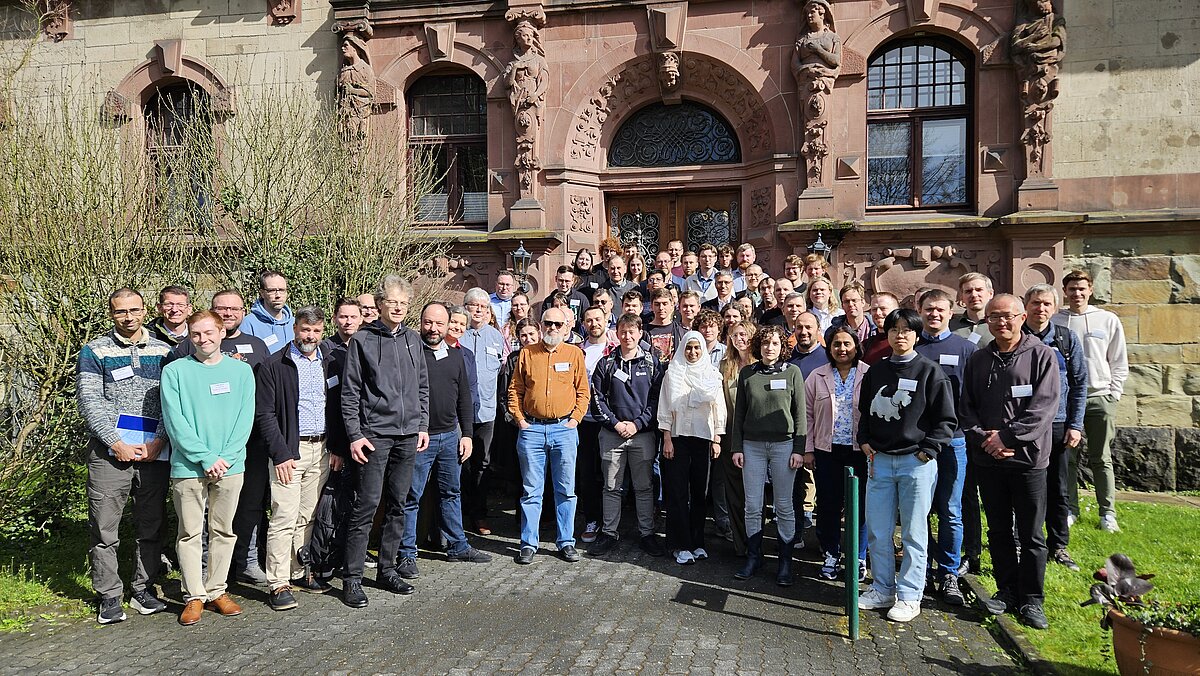
The seminar focused on quantum sensing, quantum materials, and nanoelectronic devices, with discussions spanning atomic and optical physics, magnetic sensing, metrology, topological materials, and electron quantum optics.
The University of Latvia was strongly represented both scientifically and organizationally. Members of the scientific committee from Latvia, Gunta Kunakova and Vyacheslavs Kashcheyevs, helped shape the seminar program and its Baltic-German perspective. The University of Latvia and its units were represented by 20 participants, including a large cohort of young researchers. Twelve participants from the University of Latvia were students, PhD candidates, and postdoctoral researchers, underlining the seminar’s value as a setting where early-career scientists could present their work, exchange ideas, and build international contacts.
The scientific programme highlighted how progress in quantum technologies depends on close interaction between fundamental science, materials and device engineering, and metrology. One prominent strand concerned atomic, optical, and spin-based sensing, including magnetometry, diamond-based imaging, and emerging application routes. Another focused on metrology and control at the quantum limit, ranging from quantum resistance standards to single-electron pumps, flying-electron experiments, and electron quantum optics.
For young researchers from the University of Latvia, the meeting offered not only the chance to present posters and flash talks, but also to discuss their work directly with leading researchers from Germany and other European countries.
The seminar also highlighted the University of Latvia’s role as a bridge between Baltic research groups and strong German partners in strategically important areas of quantum science and technology. Such links matter not only for individual collaborations, but also for the longer-term alignment of research efforts, training, and talent development across Europe.
The workshop was funded by the Wilhelm and Else Heraeus Foundation. At the same time, the Latvian Quantum Initiative supported travel of a large number of University of Latvia participants, making it possible for Latvian students, doctoral researchers, and senior scientists to take part actively in the scientific programme and discussions.
